Discover how interactive speech and language games can support vocabulary, speech sounds, listening skills, and communication development when used with the right guidance.
When you think about activities that help children develop speech and language skills, you might imagine reading books, playing with toys, or practicing words together.
But what about online games?
Can clicking on pictures, matching objects, or playing interactive games on a screen actually help a child develop communication skills?
The answer is that online games can create valuable learning opportunities when they’re selected thoughtfully and used with a clear purpose.
In speech therapy, a game isn’t simply something to keep a child entertained. It can become a tool for encouraging communication, practicing specific skills, and helping children participate in meaningful interactions.
The important part isn’t the game itself. It’s how the activity is used.
How Can Online Games Support Speech and Language Development?
Children learn through interaction, repetition, exploration, and meaningful experiences.
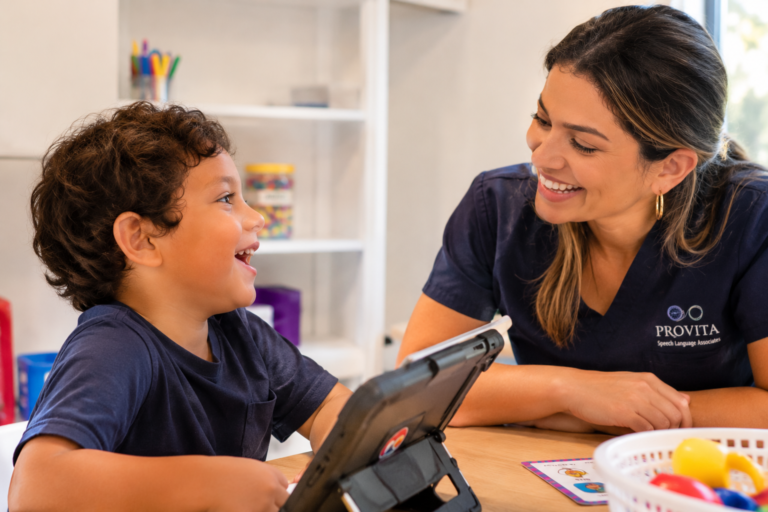
Online games can provide opportunities for these experiences, especially when an adult or speech-language therapist actively participates.
For example, an interactive game might encourage a child to identify objects, follow instructions, describe pictures, answer questions, or practice specific sounds.
A therapist can adapt the activity to match the child’s communication needs, providing support or increasing the challenge when appropriate.
This is why many online speech therapy activities involve interactive games, visual scenes, and playful challenges.
The goal isn’t simply to complete the game. It’s to create opportunities to communicate throughout the activity.
1. Vocabulary Games: Learning and Using New Words
Vocabulary development involves more than memorizing the names of objects.
Children also learn what words mean, how they relate to one another, and how to use them in different situations.
Interactive matching games, picture identification activities, and category games can provide opportunities to practice these skills.
For example, imagine a game where a child needs to identify different foods.
A therapist might encourage the child to name each item, describe its color, explain what it tastes like, or identify which foods belong together.
A simple picture of an apple could lead to several different communication opportunities:
- “What is this?”
- “What color is the apple?”
- “What can we do with an apple?”
- “Can you name another fruit?”
The activity can be adjusted depending on the child’s language level and goals.
2. Speech Sound Games: Making Practice More Engaging
Some children attend speech therapy because they have difficulty producing certain speech sounds clearly.
Speech sound practice may involve repetition, but that doesn’t mean every activity has to feel repetitive.
Interactive games can help incorporate target words into an engaging activity.
For example, a child practicing the /k/ sound might work with words such as cat, car, and cup.
A therapist could use a picture game where the child identifies each item, practices the word, and receives feedback before moving to the next part of the activity.
As the child develops, practice may progress from individual sounds to words, phrases, sentences, and eventually everyday conversation.
The game provides motivation and opportunities for practice, while the therapist guides the accuracy and progression of the skill.
3. Listening Games: Supporting Language Comprehension
Understanding language is just as important as expressing it.
Some children may have difficulty following directions, understanding questions, or processing information presented verbally.
Interactive listening games can provide opportunities to practice these skills.
For example, a therapist might ask a child to:
- Find the small blue ball.
- Choose the animal that lives in the ocean.
- Put the dog next to the tree.
- Select the picture showing someone brushing their teeth.
- Complete two actions in the correct order.
These activities can target vocabulary, descriptive concepts, spatial relationships, and following directions.
The therapist can observe whether the child understands the instructions independently or benefits from additional support.
4. Storytelling Games: Building Sentences and Expressive Language
Storytelling activities can encourage children to organize ideas, describe events, and use more complex language.
An online game might involve arranging pictures in a sequence, describing what a character is doing, or predicting what happens next.
For example, a child could see three pictures showing someone planting a seed, watering it, and watching a flower grow.
A therapist might ask:
“What happened first?”
“What did the girl do next?”
“Why did the flower grow?”
These questions can support sentence formation, sequencing, vocabulary, and language organization.
For children working on more advanced language skills, the therapist may encourage explanations, predictions, or longer descriptions.
5. Turn-Taking Games: Encouraging Social Communication
Communication isn’t only about knowing words or producing sounds.
It also involves interacting with others.
Some children benefit from support with skills such as taking turns, asking questions, responding to another person, or maintaining a conversation.
Interactive games can create natural opportunities to practice these skills.
For example, a therapist and child might take turns choosing objects or completing parts of a shared activity.
During the game, the therapist may model phrases such as:
“My turn.”
“Your turn.”
“Can I have a turn?”
“What should we do next?”
These interactions can help children practice communication skills in a structured but engaging environment.
Are Online Games Effective Without a Speech Therapist?
Online games can be enjoyable and may create opportunities for language-rich interaction at home.
However, playing a speech and language game is not the same as receiving speech therapy.
A speech-language therapist selects activities based on an individualized assessment and specific therapeutic goals.
They also observe the child’s responses, provide feedback, adjust the level of difficulty, and monitor progress over time.
Without this guidance, a game may still be entertaining, but it may not address the communication skills a particular child needs to develop.
Parents can certainly use age-appropriate games to encourage interaction, but children with speech or language concerns may benefit from professional evaluation and individualized recommendations.
How Can Parents Make Online Games More Meaningful at Home?
You don’t need to turn every game into a formal learning activity.
Instead, focus on creating opportunities for communication while your child plays.
Here are a few simple ideas:
Play together when possible. Rather than leaving your child to interact with the screen independently, participate in the activity and respond to what interests them.
Talk about what’s happening. Describe actions, name objects, or make simple comments related to the game.
Offer choices. Encourage your child to communicate preferences, whether through words, gestures, pictures, or another communication method.
Allow time to respond. Give your child opportunities to process information and communicate without rushing to answer for them.
Keep the experience enjoyable. If your child becomes frustrated or loses interest, it’s okay to change activities or take a break.
Remember that online games are only one option. Reading, pretend play, outdoor activities, and everyday routines also offer valuable opportunities for communication.
How Are Games Used During Online Speech Therapy?
During Online Speech Therapy, interactive games may be incorporated into sessions to support individualized communication goals.
A therapist might use a picture game to practice vocabulary, a matching activity to work on listening skills, or a storytelling challenge to encourage sentence formation.
The same activity can be adapted for different children depending on their abilities, interests, and therapy objectives.
This flexibility can make interactive activities useful tools during virtual sessions.
However, online therapy isn’t the ideal option for every child. A qualified professional should consider the child’s individual needs when determining whether virtual sessions are appropriate.
The Most Important Part of a Game Is the Interaction
It’s easy to focus on the colorful pictures, animations, or exciting challenges that make online games appealing to children.
But when it comes to communication development, the most meaningful opportunities often happen through the interaction surrounding the activity.
A question that encourages a child to think.
A pause that gives them time to respond.
A new word modeled during play.
A conversation that develops naturally from something they enjoy.
These moments can turn a simple activity into an opportunity for learning.
At Provita Speech Language Associates, we believe therapy should reflect each child’s individual needs, strengths, and interests.
Our goal is to create meaningful opportunities for children to develop communication skills while helping families understand the purpose behind the activities used in therapy.
Curious About Online Speech Therapy for Your Child?
If you’re wondering whether virtual sessions could be a good fit for your child’s communication needs, our team is here to help.
Provita offers personalized pediatric speech therapy services, including online sessions designed around each child’s individual goals.
💜 Contact Provita to learn more about our online therapy services and ask about our FREE Online Therapy Trial.
🌎 provitaspeech.com
📍 In-Person & Online Available
📞 (954) 666-2942
📞 (561) 308-9792