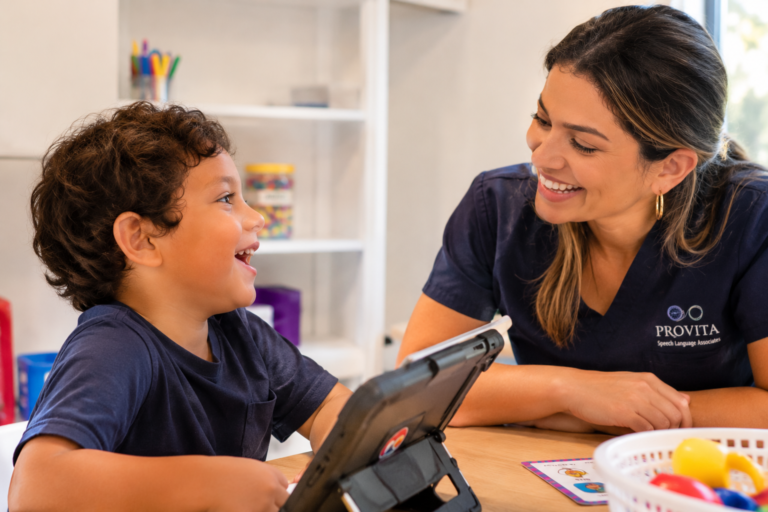
Discover how games, visual activities, and meaningful interactions during online speech therapy can help children develop communication skills—all from the comfort of home.
If you’ve ever watched your child participate in an online speech therapy session, you may have wondered:
“Are they really learning, or are they just playing games on a screen?”
It’s a completely understandable question.
After all, when we think about therapy, we often imagine structured exercises, repetition, and direct instruction. But during a virtual session, you might see colorful games, silly characters, interactive pictures, or a therapist asking playful questions.
What may look like simple entertainment can actually be a carefully planned opportunity to develop important communication skills.
The difference isn’t necessarily what the activity looks like. It’s what the speech therapist is helping your child learn through it.
Online Speech Therapy Is More Than Screen Time
There’s an important difference between a child independently watching videos or playing digital games and participating in a therapist-guided online session.
During Online Speech Therapy, a speech-language therapist uses interactive activities to address specific communication goals.
Every question, prompt, or opportunity to respond can serve a purpose.
For example, a therapist might use a game involving different animals to encourage a child to name objects, describe actions, follow directions, or practice a particular speech sound.
The child may be having fun, but the therapist is paying attention to how they communicate, what support they need, and how they respond throughout the activity.
The screen is simply the tool that allows these interactions to happen.
Why Do Speech Therapists Use Games During Virtual Sessions?
Play is a natural and meaningful part of childhood.
For many children, games can make communication activities more engaging and encourage active participation.
Instead of asking a child to repeat words without context, a therapist might incorporate those same words into a game that involves making choices, taking turns, or solving a problem.
This approach can create opportunities for children to practice communication skills while participating in something they enjoy.
However, the activity is selected based on the child’s needs—not simply because it’s entertaining.
A therapist may use the same game in completely different ways depending on the goals of each child.
What Is My Child Actually Learning During These Activities?
Let’s look at a few examples of how common online activities may support specific speech and language goals.
1. Interactive Games: Practicing Vocabulary and Language
Imagine a game where your child needs to find objects hidden in a picture.
The therapist might ask:
“Where is the dog?”
“What is the boy doing?”
“Can you find something we use to eat?”
These questions can provide opportunities to practice vocabulary, language comprehension, describing actions, and answering questions.
For a child working on sentence formation, the therapist might encourage a longer response, such as “The dog is under the table,” instead of simply naming the object.
The goal depends on the child’s individual communication needs.
2. Visual Activities: Understanding and Following Directions
Pictures, matching games, and interactive scenes can also support receptive language skills—how children understand spoken language.
A therapist might ask a child to:
- Find the red balloon.
- Put the cat next to the house.
- Choose the picture showing someone sleeping.
- Follow two directions in a specific order.
These activities can help the therapist observe how a child understands vocabulary, concepts, and instructions.
They can also reveal whether the child needs additional support or is becoming more independent.
3. Speech Sound Games: Practicing Clearer Speech
For children working on speech sound production, online activities can provide structured opportunities for practice.
A therapist might use pictures, word games, or interactive challenges featuring a target sound.
For example, a child practicing the /s/ sound might work with words such as sun, sock, or sand.
The therapist listens carefully, provides appropriate feedback, and adjusts the activity based on the child’s performance.
The game helps create opportunities for practice, but the therapist’s professional guidance is what connects the activity to the child’s speech goals.
4. Conversations and Turn-Taking: Building Social Communication
Not every online therapy activity involves a game.
Sometimes, a therapist may use conversations, storytelling, or shared activities to support communication.
A child might practice asking questions, responding to another person, taking turns, explaining an idea, or staying engaged in an interaction.
These are important skills that children use when communicating with family members, classmates, and other people in their daily lives.
How Do Therapists Know If Online Speech Therapy Is Working?
One of the most important things to understand is that online therapy isn’t simply about keeping a child entertained.
Speech-language therapists work toward individualized goals and observe how children respond during sessions.
They may monitor:
- How accurately a child produces a particular speech sound.
- Whether they answer questions with or without assistance.
- How consistently they use new vocabulary.
- Whether they follow directions more independently.
- How they participate in communication activities.
- Whether developing skills begin to appear in everyday situations.
These observations help therapists understand a child’s progress and determine whether activities or strategies need to be adjusted.
A child who needs fewer prompts, responds more independently, or begins using a skill in new situations may be demonstrating meaningful progress—even when the activity looks like play.
Does My Child Need to Sit Still the Entire Time?
Not necessarily.
Many parents worry that their child won’t be able to participate in online therapy because they have difficulty sitting still or maintaining attention.
But effective participation doesn’t always mean remaining seated and looking at the screen throughout an entire session.
Depending on the child’s age, needs, and therapy goals, a therapist may incorporate movement, familiar toys, interactive activities, or caregiver participation.
Some children benefit from shorter activities and frequent transitions, while others respond well to more structured tasks.
The important consideration is whether the therapist can create meaningful opportunities for communication in a way that works for the child.
Online therapy may not be the best option for every child, and that’s okay. An individualized evaluation can help determine which approach may be appropriate.
What Role Do Parents Play in Online Speech Therapy?
One potential benefit of teletherapy is that parents may have opportunities to observe the strategies being used during sessions.
You might notice how the therapist gives your child time to respond, models a new word, encourages a request, or builds communication opportunities into play.
These strategies can sometimes be incorporated into familiar routines at home.
For example, if your child is working on making requests, your therapist may suggest simple ways to encourage communication during snack time or play.
The goal isn’t for parents to become therapists.
Instead, it’s to help families understand what their children are learning and how they can support those skills in everyday situations.
Is Virtual Speech Therapy Right for Every Child?
While online speech therapy can be an effective service delivery option for many children, it isn’t necessarily the best fit for everyone.
A child’s communication needs, attention, access to technology, required supports, and therapy goals should all be considered.
Some children may benefit from in-person sessions, while others may participate successfully in online therapy.
At Provita Speech Language Associates, we believe therapy should be individualized rather than expecting every child to respond to the same approach.
You can learn more about Provita and our approach to pediatric therapy to better understand our commitment to personalized care.
Behind Every Activity, There’s a Purpose
The next time you see your child laughing during a game, choosing pictures on a screen, or answering a therapist’s playful questions, remember:
Learning doesn’t always look like a traditional lesson.
Sometimes, meaningful communication practice happens through a game, a story, a conversation, or a moment of shared attention.
What matters is that the activity is connected to your child’s individual goals and guided by a qualified professional who understands their communication needs.
At Provita, we want families to feel informed, supported, and confident about the care their children receive.
Curious About Online Speech Therapy for Your Child?
If you’re wondering whether online therapy could support your child’s speech and language development, we’re here to help you explore your options.
Our team offers personalized pediatric therapy services designed around each child’s unique needs.
💜 Contact Provita Speech Language Associates to learn more about our online therapy services and ask about our FREE Online Therapy Trial.
🌎 provitaspeech.com
📍 In-Person & Online Available
📞 (954) 666-2942
📞 (561) 308-9792