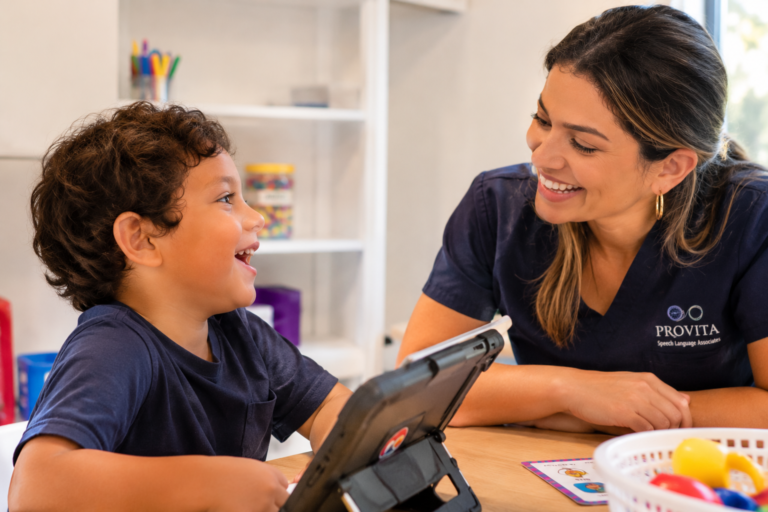
Wondering how speech therapy works and how therapists track improvement? Learn how personalized speech therapy goals, observations, and everyday communication milestones help measure your child’s progress.
When your child starts speech therapy, one of the most natural questions to ask is:
“How will I know if my child is making progress?”
Maybe you’re hoping to hear more words, clearer speech, or longer sentences. Perhaps you want your child to express their needs more easily or feel more comfortable communicating with others.
These are all meaningful goals. But what many parents don’t realize is that speech therapy progress isn’t always measured by the changes we can immediately hear or see.
Sometimes, progress looks like answering a question without help, following a direction more independently, or using a communication skill in a new situation.
And those small changes can tell us a lot about how a child is developing.
How Does Speech Therapy Work?
Speech therapy is not a one-size-fits-all process.
Every child has different strengths, challenges, and communication needs. That’s why therapy typically begins with an evaluation to better understand how the child communicates and which areas may benefit from support.
A speech-language pathologist may assess different aspects of communication, including speech sounds, vocabulary, language comprehension, sentence formation, and social communication.
Depending on the child’s needs, the evaluation may also consider other ways they communicate, such as gestures, pictures, or augmentative and alternative communication (AAC).
From there, the therapist develops individualized speech therapy goals that guide the sessions and provide a way to monitor progress.
The goal isn’t simply to complete activities. It’s to help children build communication skills that are meaningful in their everyday lives.
What Are Speech Therapy Goals?
Speech therapy goals are specific skills that a therapist and child work toward during treatment.
Rather than having a broad objective like “improve communication,” therapists identify smaller, more measurable steps.
For example, a child may be working on:
- Producing a particular speech sound more accurately.
- Answering questions with less assistance.
- Following two-step directions.
- Using longer sentences to express ideas.
- Requesting help or making choices independently.
- Participating in conversations and taking turns.
- Using an AAC system to communicate more effectively.
These goals are selected according to the child’s individual needs and may change as new skills develop.
The purpose of setting goals is to make therapy intentional, personalized, and measurable.
How Do Speech Therapists Track Progress?
Speech-language therapists use different methods to observe how a child responds during therapy.
They may collect information about how accurately a child completes a task, how often a skill is demonstrated, or how much assistance is needed.
For example, imagine a child working on answering “where” questions.
At the beginning of therapy, the child may need frequent verbal prompts or visual support to respond.
Over time, the therapist might notice that the child is answering more questions independently.
Even if the child hasn’t fully mastered the skill, needing less assistance can be an important sign of progress.
Therapists may also monitor how consistently a skill is used and whether the child can apply it in different activities or situations.
This information helps them determine whether the current approach is effective or whether adjustments may be helpful.
Why Small Improvements Can Be Important
Parents often look for major milestones.
A first word. A complete sentence. A speech sound that finally becomes clear.
But communication development involves many smaller steps.
Before a child consistently uses a new word, they may need to understand its meaning, recognize when to use it, and practice using it in different situations.
Before a speech sound becomes clear in everyday conversation, a child may first learn to produce it in isolation, then in words, phrases, and sentences.
These steps can take time.
A small improvement during therapy may represent an important part of a much larger communication goal.
That’s why speech therapists pay attention to changes that parents may not immediately recognize.
Why Does My Child Do Something in Therapy but Not at Home?
This is another common question.
Sometimes, children demonstrate a new communication skill during a structured therapy activity but don’t use it consistently in everyday situations.
That doesn’t necessarily mean they haven’t learned anything.
Using a skill during therapy and applying it independently in different environments can be separate stages of learning.
For example, a child might produce a speech sound accurately while practicing with a therapist but still have difficulty using that sound during spontaneous conversation.
Therapists often work toward helping children use developing skills across different situations, an important process known as generalization.
Parents and caregivers can play a valuable role by sharing what they notice at home and following individualized recommendations from the therapist.
How Often Should Parents Expect to See Progress?
There isn’t one timeline that applies to every child.
Speech therapy progress can depend on many factors, including the child’s communication needs, developmental profile, therapy goals, opportunities for practice, and response to intervention.
Some skills may develop relatively quickly, while others require more time and repeated opportunities.
Progress may also be uneven. A child might demonstrate noticeable improvement in one area while continuing to work on another.
Instead of comparing your child’s progress with someone else’s, it’s more helpful to focus on their individual goals and the changes happening over time.
If you have concerns about the pace of progress, your child’s therapist can explain what they’re observing and whether the treatment plan needs to be reviewed.
How Can Parents Stay Involved in Their Child’s Progress?
You don’t need to become a speech therapist to support your child’s communication development.
One of the most helpful things you can do is stay informed about what your child is working on.
Consider asking your therapist questions such as:
- What communication goal is my child currently practicing?
- What improvements have you noticed recently?
- Is my child becoming more independent with this skill?
- What should I look for at home?
- Is there a simple activity we can incorporate into our daily routine?
Sharing your own observations is equally valuable.
You may notice your child asking for help more often, using a new word during play, or communicating more confidently with family members.
These everyday moments can provide useful information about how therapy skills are developing outside sessions.
Does Online Speech Therapy Measure Progress Differently?
The format of therapy may change, but the importance of individualized goals and progress monitoring remains the same.
During online speech therapy, speech-language therapists can observe communication skills, track responses, and adjust activities according to the child’s needs.
Interactive games, visual activities, conversation, and caregiver-supported routines may all provide opportunities to practice and monitor specific goals.
For children who are appropriate candidates for virtual sessions, therapy can remain structured around measurable communication objectives.
As with in-person care, the therapist considers the child’s individual needs when evaluating progress and determining next steps.
Understanding Progress Helps Families Feel More Confident
When parents understand what their child is working toward, it becomes easier to recognize meaningful achievements.
A child who needs fewer prompts, communicates more independently, or begins using a new skill outside therapy may be demonstrating important progress—even when those changes seem small.
At Provita Speech Language Associates, we believe families deserve to understand their child’s communication journey.
Our approach emphasizes personalized therapy goals, professional guidance, and collaboration with parents and caregivers.
Families looking for Speech Therapy West Palm Beach can explore our in-person services, while those interested in flexible care can learn more about our online therapy options.
You can also learn more about Provita and our approach to pediatric therapy.
Because meaningful progress isn’t always about how quickly a child reaches a milestone. It’s about building communication skills that make a difference in their everyday life.
Have Questions About Your Child’s Speech Therapy Progress?
Whether your child is just beginning their communication journey or you’re wondering if additional support may be helpful, our team is here to guide you.
💜 Contact Provita Speech Language Associates to schedule a speech and language evaluation and learn how personalized therapy can support your child’s development.
🌎 provitaspeech.com
📍 In-Person & Online Available
📞 (954) 666-2942
📞 (561) 308-9792